Tuesday, November 6, 2012

Seoul


Seoul might be just another Asian city, with bright lights and shopping streets and bobbing, shiny black hair-cuts, but it also has markets, street food, and city smells that give it a bit grittier feel. My 4-day weekend whirlwind trip was a perfect sampling of what Seoul had to offer, leaving me satisfied but not opposed to a return venture.

Lindsey (Luther College grad!) and I took the bus from the airport into downtown. I always love that trip from the outskirts to the heart of the city, even though I know I shouldn’t. I’m never dressed for the weather, my teeth are usually fuzzy,  my bags and I are often wedged into uncomfortable positions….and I inevitably have to pee.
But it’s a good introduction to a place to watch the scenery shift and change, to glimpse areas for exploration, and take in the fact that you are now on an adventure in a new place.

This ride was no exception, as we wove through busy streets and crossed a wide river, mountains jutting up from apartment blocks.

We jumped off at what happened to be the perfect stop at the head of ‘our’ street: Insadong-il, a pedestrian street thronging with Saturday strollers taking in the shops, art galleries, cafes, and street snacks… seranaded by street performers, of course.


After checking into our cheap-and-clean-but-nothing-fancy hotel, it was off for temple and palace explorations. Jongmyo  shrine was shady and pleasant, with paths of stone and tile-roofed buildings scattered about.  The sound of loud chanting led us to the large, open courtyard in front of one of the main buildings.  The long hall, shuttered behind red doors, houses spirit tablets believed to be the resting place for the spirits of the departed. Today, the courtyard was the setting for a re-enactment of a royal wedding, which entailed much chanting, bowing, uncomfortable-looking dresses, and a brightly dressed honor guard standing at attention. A mysterious female voice explained the goings-on in several languages, as shutterbugs clicked and dragonflies flit about through the sunshine. 


Destination #2 was Changgeong-yung palace, which has been rebuilt on a much smaller scale than the massive original, but gets the idea across with large open courtyards surrounded by covered porticoes, and various residences and temples, all sporting colorful designs in blue and green above the now-familiar rusty-red wood.  After a quick spin through the gardens we headed to an exit… to yet another palace! They feel rather desolate now, but back when they were populated with royalty I suppose the open spaces were filled with ladies strolling, servants bustling, scholars thinking…


Back in Insadong we discovered a 3-story mecca of kitsch and cute, with a place to sit on the rooftop and watch people stream by, where wooden hearts hung with messages of love and two giraffes grazed on the sky.

Dinner that night was delicious – after meeting up with Luther grad #3, (Anne, just finishing up her student-teaching) we had a feast – a giant spring onion pancake, spicy tofu soup, grilled pork, bimimbap in a sizzling stone bowl, and (my favorite feature of korean food) an assortment of side dishes – spicy kimchee and small mounds of vegetables in various stages of pickling. 


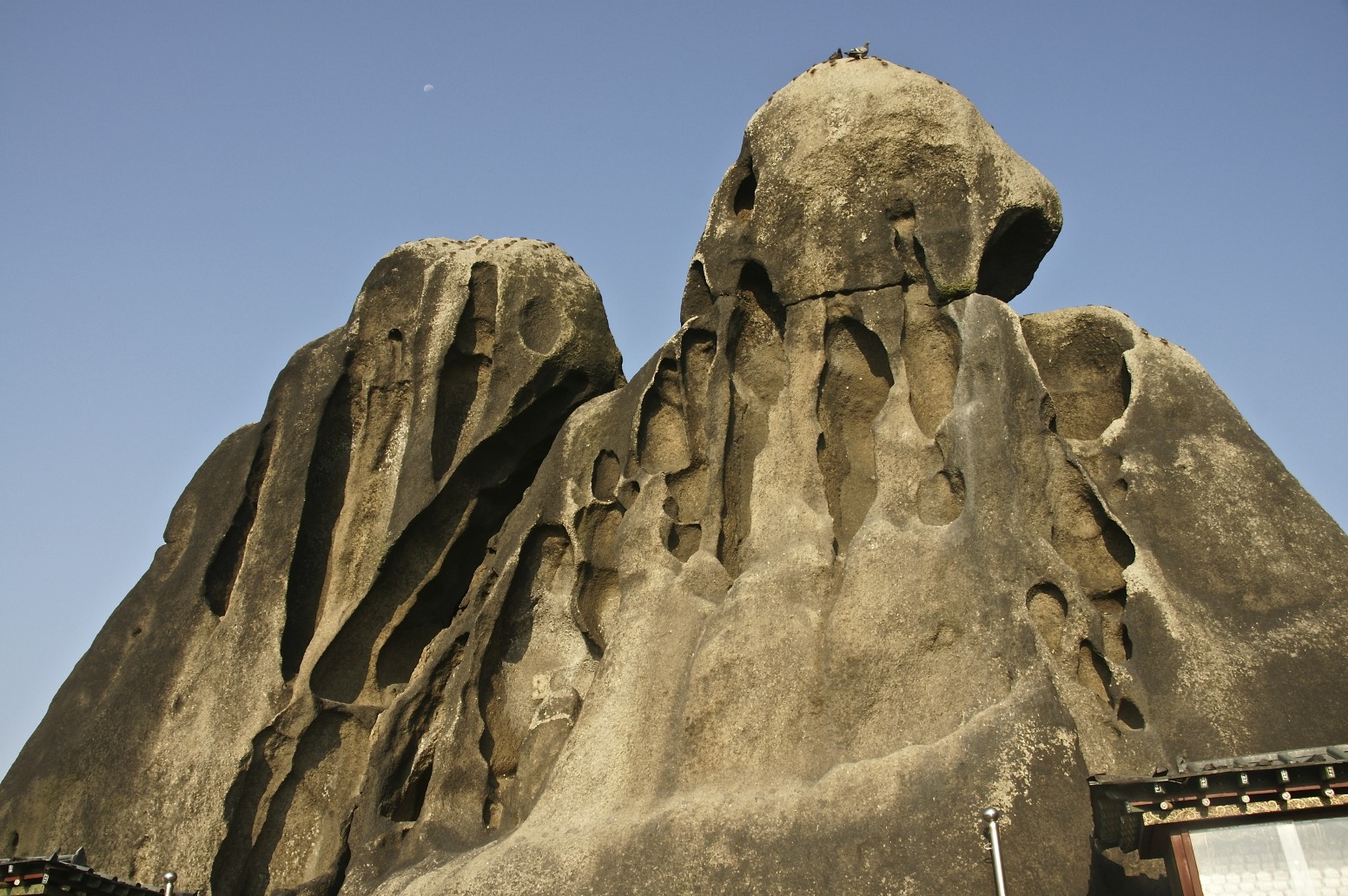
Day #2 I got up early and headed on a little solo adventure to Ingwansang, a sacred mountain in the heart of the city, a holy place for Buddhists as well as Shamanists. It was early on a Sunday, so things were barely stirring as I hiked up the road from the station and passed some colorful shrines and a scattering of homes before coming across the Seon-bawi, a sacred rock that (with a bit of imagination) looks likes two hooded monks. A woman next to me prostrated three times in succession on her small mat, as a voice began chanting as if from nowhere. Inrigued, I looked behind the wall to see a Shamanist women seated on the ground, chanting as she followed along from a book, her voice rising and falling. 


I continued up the mountain, wandering past multiple places that were clearly for these same sort of ritual – flat and swept clean, tucked into corners and down small trails.

There are several fascinating rock formations on the mountain, and combined with the ever-expanding views of the city, it was an interesting climb. The final stretch was along the old (but now re-built) city wall, and my climbing was rewarded with views of the city stretching away to the horizon, the river shimmering and the beige high-rises in stark contrast to green hills.


I didn’t dawdle on my way down, because it was time for the DMZ tour!
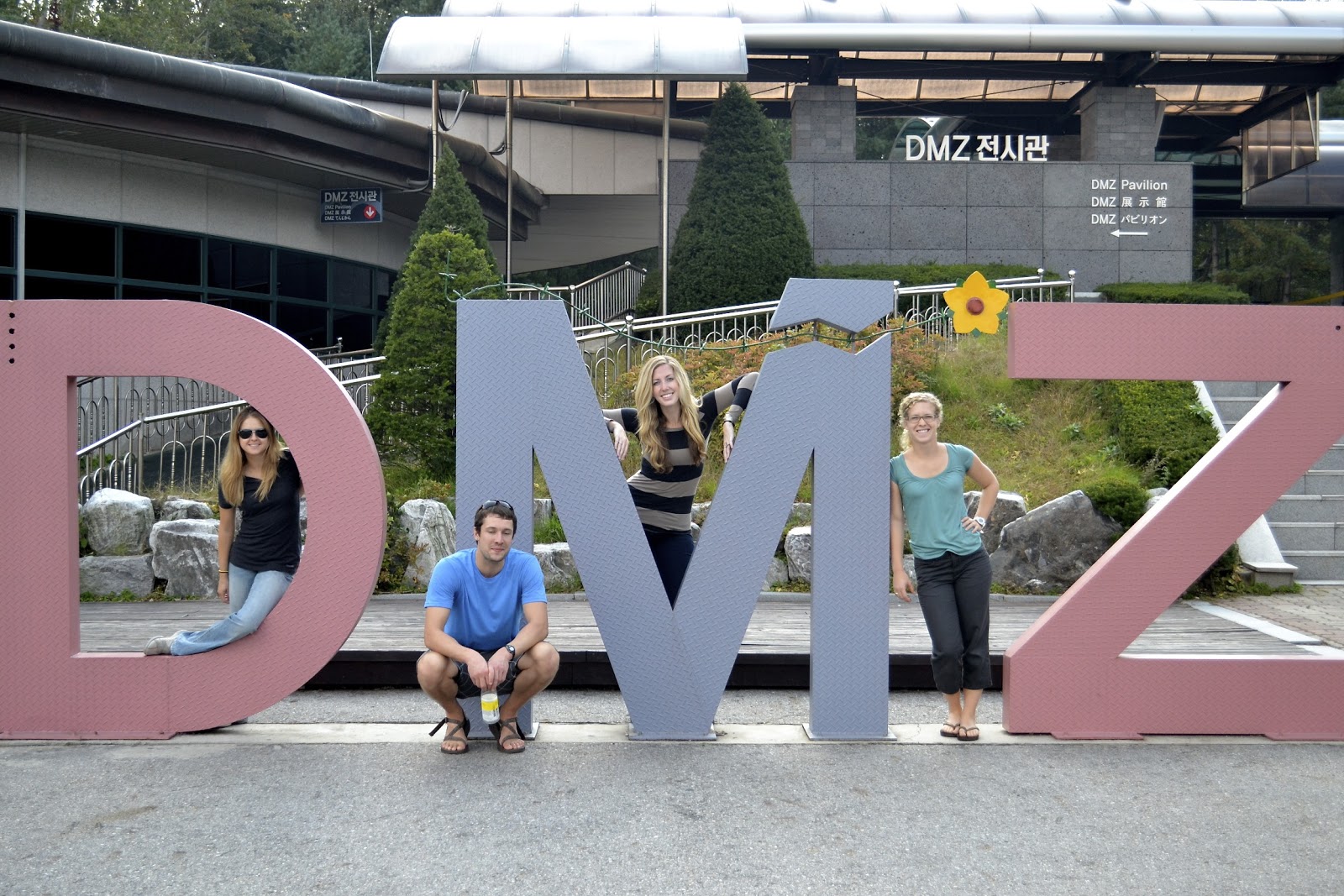
We met up with Timmy and Karl, also in town from ASIJ, and the rest of our tour group, heading north along the river for a mere 40 minutes before stopping to check in at the checkpoint. It was bizarre, here just minutes from the miliary zone, to encounter an amusement park in full weekend swing, kids screaming delightedly and kites flying in the breeze. We loaded up with other groups into our ‘official, military-approved’ bus, which was a decked-out coach bus that was the complete opposite of the bare-bones prisoner bus I was expecting, and passed into the South Korean Military Zone.  We saw lots of signs warning of land mines, the 3rd Infiltration Tunnel (discovered before it could be used to actually infiltrate), a birds-eye view of the actual DMZ and North Korea (complete with propoganda villages on both sides of the 38th parallel, sporting flagpoles that defy the imagination in an effort to be the tallest), and a train station with tracks to nowhere (built when things were looking up and people thought they would need to get to Pyeongyang.).

It was an interesting tour and eye-opening to realize that distrust is still so prevalent and tensions still high.  (It also made me wonder if north-korean tourists were looking at us through their high-power binoculars.)


Day#3,  Lindsey and I headed south to Suwang, an ancient walled city that is now a modern city surrounded by a new version of the wall. The bus droppped us in a massive roundabout, with cars and exhaust and shops and people…and then we walked one block away and calm enveloped us, the back streets populated by a few bicycles and retired men sitting in the park, and the wall climbing the ridge in front of us.  It was a beautiful day and we enjoyed walking up and along the fortress wall, stopping at guard-posts along the way to admire the view, before descending back into the rush of modern life, checking out some markets and a lovely canal before heading back into Seoul.


 We caught the sun-set from N. Seoul Tower, perched high upon a hill overlooking the city, before heading down into Nandaemun market, whose myriad buildings we barely scratched the surface of, opting for  a wander through the outdoor stalls, and a spring-onion pancake eaten perched on plastic stools, watching seafood cooked in a beautiful mess of hissing steam and sauces before being served up alongside cold beer pulled from the cooler. 


The last day was spent with some more wanderings: through markets and temples and hill-top neighborhoods, soaking up what we could before heading to the airport. 


Want to see all the pictures? Click here!


Sunday, September 16, 2012

Mikoshi 2.0


Last weekend I had the opportunity to get up-close and personal with the matsuri (festival) of a quiet Tokyo neighborhood, thanks to one of my lovely colleagues, Kyoko,  who extended an invitation to her home and a chance to be involved in carrying the mikoshi through the streets to the local temple.

Having seen the physical exertion involved with this particular ritual, I opted for the shutter-bug route, but two of our new-to-Tokyo friends were brave enough to give it a try. Lindsey and Brendan got garbed up in their linen clothes and donned their borrowed happi coats. The coats are particular to each neighborhood, so Kyoko's husband, no stranger to the annual event, had borrowed some extras. The carriers also traditionally wear soft white boots that have a split toe.


We wove through the neighborhood and popped out rather suddenly onto the main shopping street, where shoppers intent on their tasks tried to dodge the mikoshi crowds. As 'our' mikoshi was getting ready to go, we wandered down the road and met another procession coming towards us, chanting and bobbing and weaving past shops and restaurants and bars.


This yearly festival is a chance for the neighborhood to come together and honor the god of the area shrine, so the 'portable' shrines are carried from their usual resting places to the larger shrine in the area. Along the way, they pause to show respect to shrines or businesses that have been generous donors through the years.


It is not merely a straightforward march - the three large poles are shouldered by three lines of happi-coat-wearing people, who begin to chant and dance in place before starting off down the street in a bouncing gait.  The person with the whistle is clearly in charge, giving long blasts to start moving and shorter ones to keep everyone on the beat, while the chanting grows in intensity... I"m still not sure exactly what they are saying, but it's repetitive and almost hypnotic. (And then, suddenly, after about an hour, rather irritating).


People change places as they get tired, and a small entourage follows the process. There are a few rest stops along the way, where saw-horses appear from nowhere to hold the mikoshi's weight for awhile as the tired, sweaty carriers grab a drink from the trays that also appear as if by magic. When ready to move again, the guy with the wooden blocks is hoisted up and gives a few sharp, ringing claps to alert everyone that it's time to carry on.


Upon reaching the shrine, the team is blessed and takes a rest break under the beautiful trees as families meander through the stalls set up with games to play and food for sale. Then, rest break over, they retrace their steps back through the streets.


You can check out the complete gallery here!

Sunday, September 2, 2012

Suburban Saturday

Ahhh, weekends.

Those 2 days of blissful relaxation.  Or perspiration. Or exploration. Or organization.

I wanted to take advantage of this one, before the school year really hits its stride.

So, off to explore some of the peaceful green spaces out here in the western tokyo suburbs.

The Edo Tokyo Open Air Architectural Museum (no acronym for that one!) is located in one corner of the expansive Koganei-koen a mere 15 minutes from my house by bike.

From the museum website:
"Since the Edo period, Tokyo has lost many valuable historical buildings because of fires, floods, earthquakes and warfare. Today, the city’s valuable cultural heritage is still being eroded due to social and economic changes.

In 1993, the Tokyo Metropolitan Government established the seven-hectare Edo-Tokyo Open-air Architectural Museum as part of the Edo-Tokyo Museum. This museum aims to relocate, reconstruct, preserve and exhibit historical buildings of great cultural value that are impossible to preserve at their actual places as well as to inherit these valuable cultural heritages to future generations."


I was amazed at how fascinating a bunch of old houses can be! Quite a few were houses of rich families or architects, and provided a fascinating mix of western and japanese styles. Some had opulent carpeting, others maintained the more traditional wood flooring - all had tatami rooms of various sizes and number. There were also some farmhouses, with a lower area of earthen floor and a step-up to the 'clean' area, with in-house fire pits for cooking and making tea in oh-so-clever hanging teapots. Our final moments were spent in the shops of a 'main street' including a public bath house. 


 In a stunning example of the trusting efficiency of Japan, there were an array of umbrellas waiting in stands at each house - dainty, frilly varieties for shading delicate skin from the sun; serious, large varieties for guarding visitors (and their cameras) from raindrops. So even as the rain came pouring down, we were able to move between the houses in a relatively dry state. (Once we figured out the difference in umbrellas, of course!)


Curiosity sated, we continued on our adventure by taking a leisurely bike ride along the Tamako Bike Road, which cuts through the suburbs from Mitaka to the Tama Lake resevoir. It passes train stations, community gardens, schools, and residential areas before ending at a beautiful park at the edge of Tama Lake. Just another example of the availability of peaceful green space even in the hustle and bustle of Tokyo. As someone so sagely noted as we pedaled under a canopy of leafy green, it's a necessity to have such spaces when so many people are living and commuting in such close proximity to each other. 


Our ride back was hastened due to the darkening skies, but we were still caught in a deluge that warranted a break under a convenient set of umbrellas (though this was nothing compared to the Great Brewery Ride of 2012, when we faced much fiercer elements.... did I not mention that? Hmmm... a story for another day, perhaps). 

Click here to see all the pics from the day if you are interested!

Sunday, August 19, 2012

Shopping Survival Guide

(or, why a smartphone should be your shopping buddy).

So, I'm back in Tokyo for year number 2.

Blissfully reunited with my blue bike, sweating in the humidity, and dusting off my Japanese.
(Apparently it's not only students who forget things over the summer).

Despite the humidity and the rusty language skills, me and the bike headed off to J-Mart to knock a few things off the settling-back-in list. J-Mart is two floors of just about anything you could want or need for your household, from furniture to dishes, cleaning products to power tools.

An hour later, delivery scheduled, I headed out of the air-con and realized that one does not need to be fluent in Japanese to get the shopping done. Only four things are necessary: time, translator, google, and some key vocabulary terms.

Time: Do not be in a hurry to get your shopping done. Many items on your list can be found by strategically wandering the aisles. Adopt a slow, relaxed pace and stroll cross-wise through the store. Glance casually at the aisles you pass. If an aisle looks promising, turn down it. If it doesn't yield the item you are seeking, simply round the end-cap and head back down the neighboring aisle. The key is to avoid looking confused by the barrage of katakana/hiragana/kanji all around you, as you want to avoid approaches by anyone hoping to help you (as you will see below, this requires another step first).

Translator: Hmmmm.....this kitchen shelf I am looking at looks like it might be a good fit for my kitchen. I measured my space and what needs to go on it... but what are these measurements on the tag?  Do we list width and then depth? Or depth and then width?
Power up the i-phone translator. Look up 'width'. Compare Kanji. Problem solved. First measurement is width.

Google: Okay. So you've found a few things by wandering, and answered a few questions by translating, but a remaining item or two are eluding your grasp. And the translating tool is not helping with 'fire extinguisher'. And miming/attempting to explain could cause more confusion than it clears up.
So, google: fire extinguisher. Pull up a nice image.
Walk up to first store employee you see. Utilize a few basic vocab terms (see below) and show him/her a picture of the item you are looking for.
Downstairs. Ok.
Repeat with employee downstairs.
There they are!
(Pause for a moment to shake head at ability to miss display of bright red, shiny things).

Key vocabulary:
Kore (this) and Arimasuka? (To be or not to be?)
Combine these two words with a picture of the desired item, and you are in essence asking "does this thing exist?" (assumption follows that you mean 'does it exist in this store,' not 'does it exist in the universe, and 'will you please show me where it is???')

Haitatsu, kudasai: delivery, please! (my bike cannot hold this much stuff!).

Kyo: Today. Word you really want to hear in reference to your delivery.

See? No problems.